
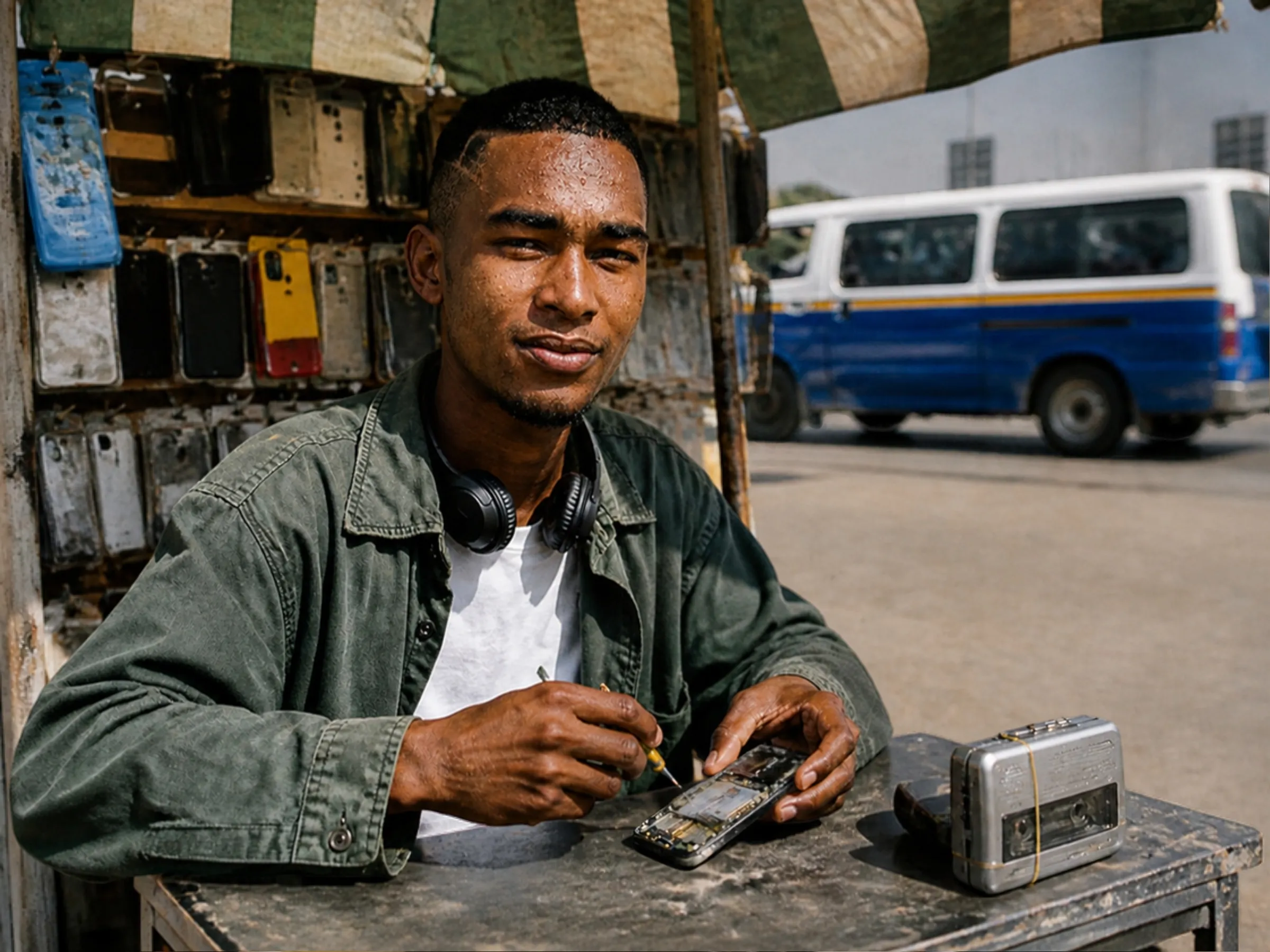
A young man in a green work jacket with headphones round his neck sits at a phone-repair stall, a screwdriver in one hand, a taken-apart phone and a cassette player on the table, a minibus passing behind. AI-generated image.

PS-D02 · Lusaka · Demo

Kalulu Tapes

A rapper from Matero who builds his beats from his grandmother's cassettes.

Watch the session

No film for this act yet.

Kalulu Tapes at his phone-repair stall in town. Photograph: Photographer — name to come.

Planting the Crown

Where it began

A shoebox of cassettes, a broken tape deck and a hare who wins by thinking. How a phone repairer from Matero started making music at night.

The shoebox lives under his grandmother’s bed in Matero. Inside are forty-one cassettes, most of them labelled in her handwriting: a wedding, a choir, songs taped off the radio, a whole side of her own voice singing to a baby who is now twenty-four and calls himself Kalulu Tapes.

“She kept everything,” he says. “Every song she liked, she pressed record.”

He found the box when he was fifteen, looking for something else. The tape deck that played them had been broken for years. He carried it to a repair stall in town, watched the man open it, and asked so many questions that the man gave him a job. He still works there, six days a week, fixing phones under a striped umbrella. It is where he learned that small things can be opened, understood and put back together.

The music started the same way. At night, in the room he shares with two cousins, he plays the cassettes into a secondhand laptop, cuts out a few seconds he likes and loops them until they become a beat. A church choir becomes a drum. A crackle becomes a hi-hat. He raps over them in Nyanja and English, quietly, because his cousins are asleep.

The name came from his grandmother’s stories. Kalulu, the hare, is the smallest animal in the bush and the cleverest. He does not win fights; he wins arguments. “I am not loud,” Kalulu Tapes says. “So I have to be clever.”

His first verses were written on the minibus between Matero and town, on the back of repair receipts. He reads them out on the ride home, under his breath, to see if they fit the rhythm of the road. Most of them do not survive. The ones that do become songs.

For a long time, no one heard them. He played beats for the man at the stall, for his cousins, and once, nervously, for his grandmother. She listened to her own voice, thirty years younger, looping under her grandson’s rap, and said nothing for a long time. Then she asked him to play it again.

This story follows him from the shoebox to the stage. The next chapter goes into the room where the beats are made, and the decision that changed them: asking his grandmother to sing.

Next: Rooting & Growth — The private work.

Rooting & Growth

The private work

Kalulu Tapes makes music in the hours other people sleep. Over six weeks, our photographer followed the work: the stall by day, the laptop by night, the wardrobe lined with blankets that serves as a vocal booth. These pictures follow the change at the centre of the story. He stopped sampling his grandmother's old recordings and asked her to sing the hook herself. Photographs: Photographer — name to come.

Process clips

  1. Cutting tapehow a few seconds of a choir become a drum.
  2. The wardroberecording vocals in a room with no quiet.
  3. Her voice, nowhis grandmother hears herself sing the hook for the first time.

Flowering · The breakthrough

Kalulu Tapes: Side B

Watch the documentary

No film for this act yet.

Kalulu Tapes has only ever performed to a laptop and two sleeping cousins. This documentary follows him through the month before his first open-mic night in Lusaka: the songs he cuts, the cassette deck that nearly fails on the night, and his grandmother deciding whether she will come. Filmed in Matero and town. In Nyanja and English, with English subtitles. Can music made alone on headphones hold a room? Directed by Director — name to come.

Ripening · The session

Who he is now

Four songs, performed in one room. The cassette deck is on the table, the loops play live from tape, and the voice stays as low as it was at midnight. The set moves from the stall to the shoebox, and ends with his grandmother singing the hook. Recording method and number of takes: to be confirmed at the shoot.

  1. 01Pang'ono Pang'onolittle by littleListen for the tape slowing down at the end of each bar; he lets it drag on purpose.
  2. 02Side BBuilt from the second side of a wedding tape. Listen for the crowd noise under the second verse.
  3. 03Minibus PsalmWritten on the ride home. Listen for the rhythm of the road in the flow, three short lines then one long one.
  4. 04Agogo's TapesThe song she sings on. Listen for the moment her voice from the cassette meets her voice in the room.

Heard in full. Now entering the archive.